
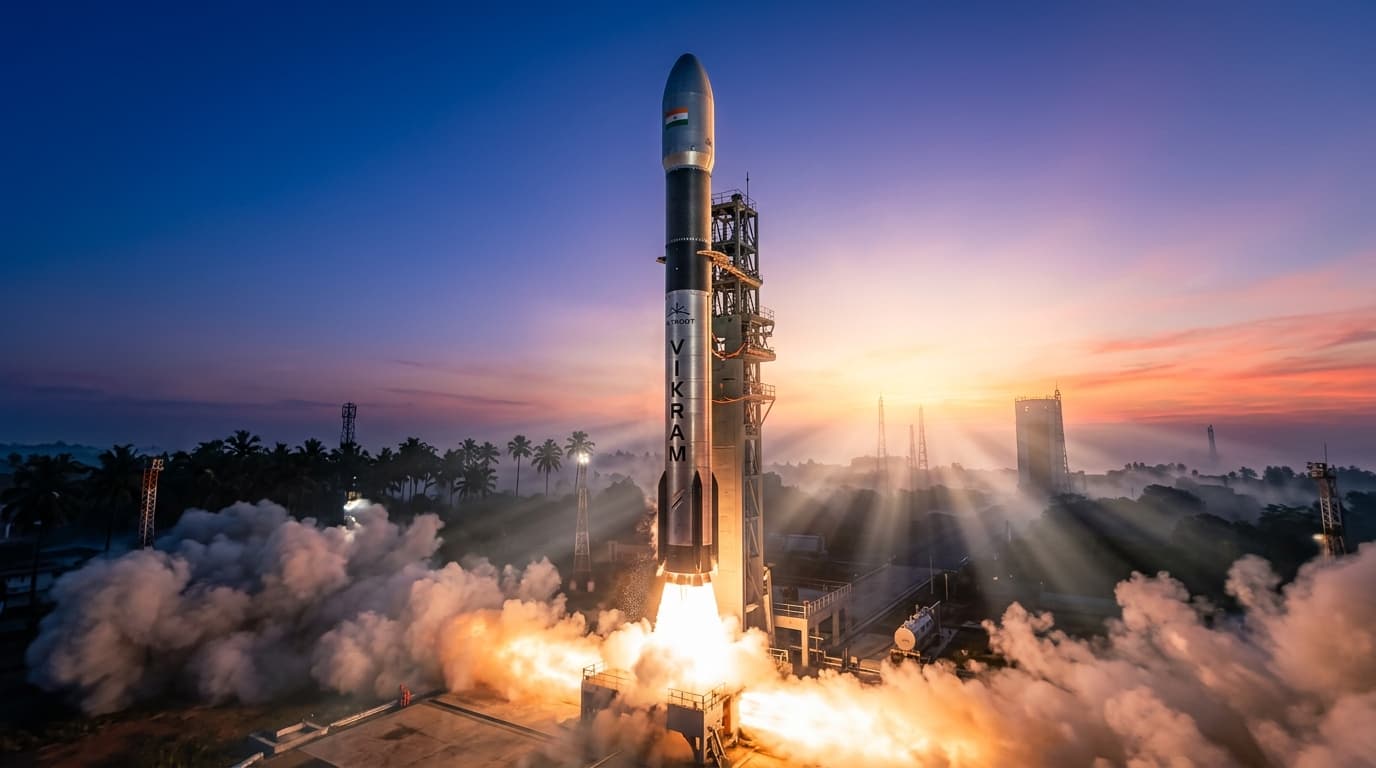
At 06:35 UTC on July 18, 2026, a slender four-stage rocket lifted off from the First Launch Pad at the Satish Dhawan Space Centre, Sriharikota. Roughly fifteen minutes later, its payload stack was in orbit. With that, Skyroot Aerospace's Vikram-1 — named for the father of India's space programme — became India's first privately developed rocket to reach orbit, and India became only the third nation on Earth, after the United States and China, with a privately built orbital launch capability.
Mission Aagaman — The Debut Flight
Vikram-1's maiden mission, named Aagaman("arrival"), carried a multi-customer rideshare stack to low Earth orbit. The payload manifest reflected the international, commercial character of the new Indian launch market: India's SCOPE and SOLARAS S3 satellites, the EMBRACE mission carrying a Cosmoserve Space robotic arm, and a cluster of Mission Aaghan sub-payloads — including German space-hardware firm DCUBED's UD3PP and mD3RN technology demonstrations alongside COSMIC BLOOM and MICRO ART TRIBUTE.
Reaching orbit on a first flight is a rare achievement in launch history — most new small-lift vehicles worldwide have needed multiple attempts. Mission Aagaman's clean success, with all payloads injected approximately fifteen minutes after liftoff, validated both the vehicle design and the launch operations model in a single stroke.
The Vehicle — Simplicity as a Strategy
Vikram-1 is a four-stage small-lift launch vehicle built around a deliberate design philosophy: three solid-fuel stages — the Kalam-1200, Kalam-250, and Kalam-100, named for Dr. A.P.J. Abdul Kalam — topped by a liquid hypergolic fourth stage driven by Raman engines. Solid stages trade some performance for simplicity: fewer moving parts, faster integration, and lower recurring cost — exactly the trade a commercial small-satellite launcher wants.
The company pairs that architecture with aggressively modern manufacturing — additively manufactured engines and carbon-composite structures — allowing a vehicle to be assembled and integrated in days rather than months. The explicit goal: "launch on demand" for the small-satellite generation, at a fraction of traditional cost and lead time.
Why the Debut Matters
A Third Nation Joins the Club
Only the US and China had previously produced a privately developed orbital rocket. Vikram-1 puts India in that company — and signals where the next generation of launch providers will come from.
Orbit on the First Attempt
New small launchers rarely succeed on debut — the global record is littered with maiden-flight failures. A clean first flight materially de-risks Skyroot's commercial manifest.
Solid-Stage Economics
The Kalam solid stages and Raman liquid upper stage trade peak performance for low part count, rapid integration, and predictable costs — built for cadence, not records.
Multi-Customer Rideshare Model
Seven payloads from Indian and German customers on one flight demonstrate a working rideshare model — the commercial backbone of every successful small-launch business.
From Vikram-S to Vikram-1 — A Four-Year Ascent
| Year | Milestone |
|---|---|
| 2018 | Pawan Kumar Chandana and Naga Bharath Daka — former ISRO engineers — found Skyroot Aerospace in Hyderabad, naming the company after Dr. Vikram Sarabhai, father of India's space programme. |
| 2020 | India opens its space sector to private enterprise; IN-SPACE is created to facilitate and authorize private launch and satellite activity. |
| 2022 | Vikram-S flies the suborbital "Prarambh" mission from Sriharikota — the first launch of a privately built Indian rocket. |
| 2026 | Vikram-1 reaches orbit on its debut, Mission Aagaman — India becomes the third nation with private orbital launch capability. |
Why It Matters — For India and the Market
India has long held a reputation for cost-effective launch through ISRO's workhorse PSLV. Vikram-1 extends that advantage into the private, small-satellite segment — the fastest-growing slice of the launch market, where constellation builders prize schedule reliability and rapid turnaround over raw payload capacity. A domestic private option also gives Indian and regional satellite operators a sovereign, commercially flexible path to orbit.
Globally, the small-launch field has been consolidating around a few proven providers. A new entrant that reaches orbit on its first attempt — with solid-stage economics and a working rideshare model — is a genuine competitive arrival, not merely a technology demonstration.
What's Next
Skyroot's roadmap scales the Vikram family toward heavier payload classes with Vikram-2 and Vikram-3, targeting higher capacity while preserving the rapid-integration philosophy. If the company converts its debut success into flight cadence, India will move from a periodic launch provider to a persistent one — with all that implies for the Asian small-satellite market, constellation deployment schedules, and the global geography of launch.