
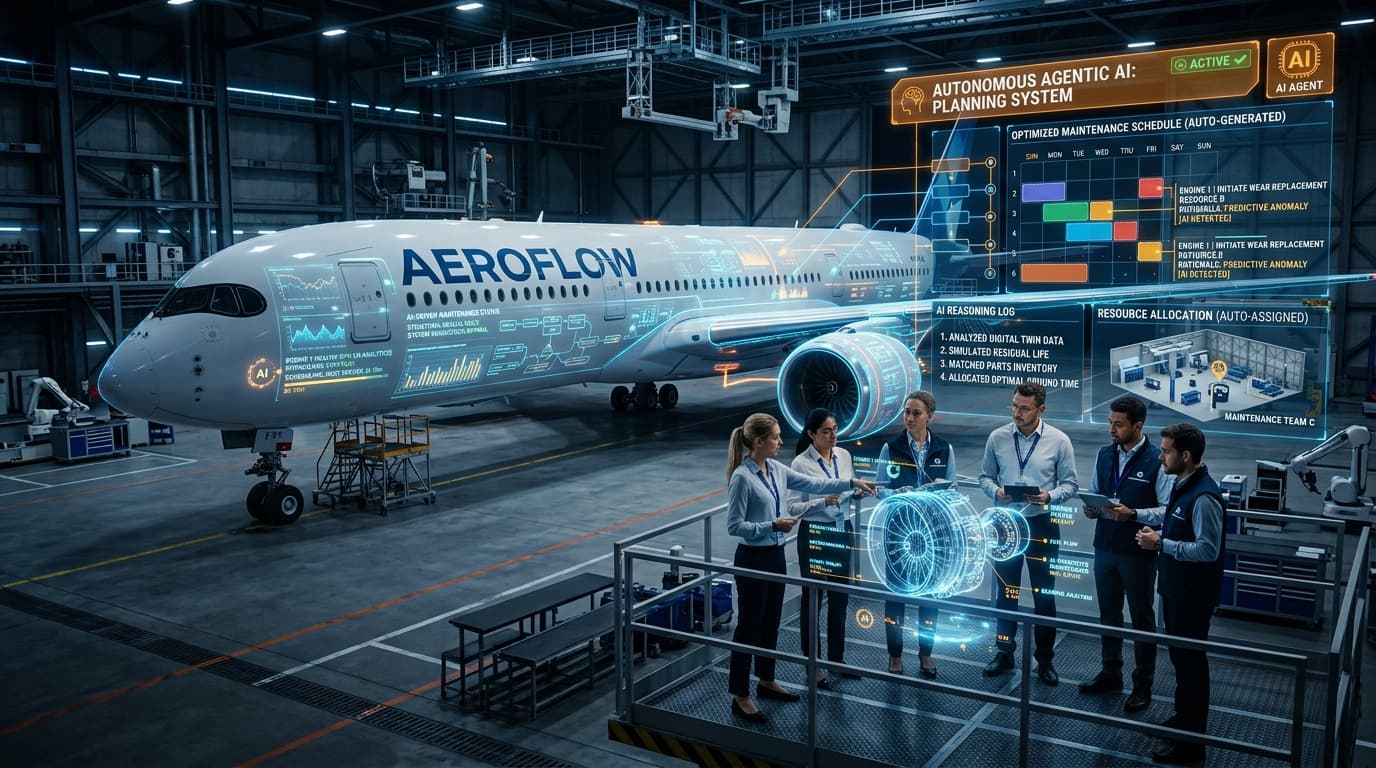
The Challenge of Modern Maintenance Planning
Aircraft maintenance planning is one of the most complex operational challenges in aviation. Fleets span multiple aircraft types, thousands of components, evolving regulatory requirements, and tight turnaround schedules. A single wide-body check can involve hundreds of tasks, dozens of technicians, and a parts supply chain measured in weeks. Under these conditions, manual planning is not just inefficient — it is a safety and commercial risk.
Agentic AI brings intelligence to every layer of maintenance planning and control. Unlike traditional optimization tools that produce a static plan, autonomous agents continuously perceive fleet condition, decide, and act — generating schedules, creating work orders, and re-optimizing in real time as operational reality changes.
How Agentic AI Benefits Maintenance Planning & Control
Intelligent Schedule Generation
Agents analyze aircraft utilization, component health data, regulatory requirements, and crew availability to generate optimal maintenance schedules that minimize downtime while ensuring full compliance.
Predictive Work Order Creation
Instead of waiting for failures, agents predict which components will need maintenance based on real-time sensor data, flight hours, cycles, and environmental conditions — creating work orders before issues arise.
Resource Optimization
Agents coordinate maintenance crews, tools, parts inventory, and hangar availability across multiple aircraft simultaneously, ensuring the right resources are available at the right time.
Dynamic Schedule Adjustment
When unexpected events occur — weather delays, component failures, crew shortages — agents automatically re-optimize schedules in real time, minimizing cascading disruptions.
Parts Demand Forecasting
Agents predict parts requirements based on maintenance schedules, component degradation rates, and fleet growth projections, optimizing inventory levels and reducing stockouts.
Compliance-Driven Planning
Agents ensure every maintenance action aligns with regulatory requirements, service bulletins, airworthiness directives, and operator-specific limitations — eliminating compliance gaps.
The Agentic AI Planning Workflow
Planning & Control: Before vs. After Agentic AI
| Traditional Planning | Agentic AI-Driven Planning |
|---|---|
| Manual schedule creation by planners | Automated intelligent scheduling |
| Fixed-interval maintenance (time-based) | Predictive condition-based maintenance |
| Reactive work order management | Real-time work order management |
| Siloed planning departments | Unified planning platform |
| Long lead times for parts | Optimized parts procurement |
| High aircraft downtime | Minimized aircraft downtime |
| Over-maintenance and under-maintenance risks | Precision maintenance targeting |
| Inefficient resource utilization | Maximized resource utilization |
Key Benefits for Maintenance Planning & Control
Real-World Impact Scenarios
Wide-Body Fleet Optimization
An airline operates 50 Boeing 777s. Agentic AI agents analyze engine health, structural data, and utilization patterns to create a unified maintenance plan that reduces fleet downtime by 30% while maintaining full regulatory compliance.
Regional Fleet Management
A regional carrier manages 30 Airbus A320s. Agents optimize maintenance scheduling across multiple bases, reducing cross-base transfers and improving crew utilization by 20%.
MRO Facility Coordination
An MRO facility handles maintenance for multiple airlines. Agents coordinate work orders, manage hangar allocation, and optimize technician scheduling across competing priorities.
Parts Supply Chain Integration
Agents predict parts demand 6 months ahead, automatically triggering procurement workflows and ensuring critical components are available when needed — eliminating costly delays.
Smarter Planning. Better Control. Safer Flights.
Agentic AI transforms maintenance planning from a reactive, manual process into an intelligent, predictive system that optimizes every aspect of aircraft maintenance operations. For planners and controllers, the agents handle the combinatorial complexity — while humans stay in command of airworthiness decisions and exceptions.